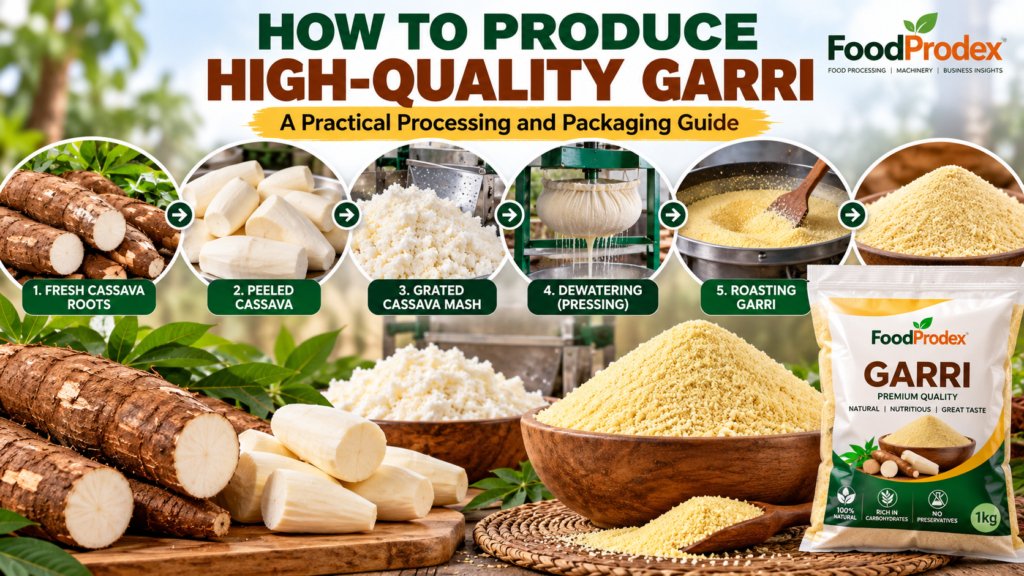
Garri is one of the most widely consumed cassava-based foods in West Africa. It is produced from fresh cassava roots through peeling, washing, grating, fermentation, dewatering, sieving, roasting and packaging.
Producing high-quality garri requires careful control of raw-material quality, hygiene, fermentation, moisture removal and roasting. Poor processing can lead to sour off-flavours, excessive moisture, uneven texture, contamination, mould growth and reduced shelf life.
The final product should be dry, clean, free-flowing and pleasantly crisp, with a characteristic flavour and uniform particle size.
This guide explains the practical steps for producing clean, commercially acceptable garri suitable for household consumption, retail packaging and small-scale food processing.
1. Selecting Fresh Cassava Roots
Use mature, healthy cassava roots that are firm and free from rot, mould, severe bruising or insect damage.
Freshly harvested cassava is preferred because prolonged storage can lead to physiological deterioration and discoloration.
Process the cassava as soon as possible after harvesting to maintain good colour, flavour and overall product quality.
2. Peeling and Washing
Remove the brown outer skin and inner peel carefully.
Wash the peeled cassava thoroughly with clean potable water to remove soil, sand and other contaminants.
Maintain good hygiene throughout the washing process because dirt introduced at this stage can reduce the cleanliness and quality of the finished garri.
3. Grating the Cassava
Grate the washed cassava roots into a fine wet mash using a clean cassava grater or suitable food-processing equipment.
Fine grating helps break down the cassava tissues and prepares the mash for fermentation and dewatering.
Avoid contamination from rusty, dirty or poorly maintained equipment.
4. Fermentation
Transfer the grated cassava mash into clean food-grade bags or containers and allow it to ferment for the desired period.
Fermentation develops the characteristic flavour of garri and contributes to product safety and quality.
The fermentation time should be controlled because too little fermentation may produce bland garri, while excessive fermentation may result in overly sour flavour.
5. Dewatering the Fermented Mash
After fermentation, remove excess water from the cassava mash using a clean press, screw press, hydraulic press or another suitable dewatering system.
The mash should become firm and crumbly rather than wet and pasty.
Effective dewatering is important because excess moisture increases roasting time, reduces efficiency and can lead to uneven texture in the finished garri.
6. Sieving and Breaking the Mash
Break up the dewatered cassava cake and pass it through a clean food-grade sieve.
Sieving helps remove lumps, fibres and coarse materials and produces a more uniform granule size before roasting.
A consistent particle size improves roasting performance, appearance and final texture.
7. Roasting the Garri
Roast the sieved cassava granules in a clean garri fryer, roasting pan or suitable mechanized roaster.
Stir continuously during roasting to prevent scorching and ensure even heat distribution.
The objective is to reduce moisture, develop the characteristic garri texture and produce dry, crisp, free-flowing granules.
Avoid excessive heat because it can darken the product, create burnt flavours and reduce quality.
8. Cooling the Roasted Garri
After roasting, spread the garri in a clean, dry and protected area to cool.
Do not package while still hot because trapped heat can cause condensation inside the package and encourage caking or mould growth.
Allow the garri to cool completely before final sieving, grading and packaging.
9. Final Sieving and Grading
After cooling, pass the roasted garri through a clean food-grade sieve to remove oversized particles, lumps and unwanted fibres.
Grade the garri according to the particle size required for the market. A uniform granule size improves appearance, mouthfeel and consumer acceptance.
Oversized particles may be broken down and sieved again if necessary.
10. Optional Fortification or Product Variation
Depending on the type of garri being produced, processors may add permitted ingredients or develop specific product variations.
For example, some products may be fortified with approved micronutrients or blended with other suitable food ingredients. Yellow garri may be produced using an appropriate edible oil source where locally accepted.
Any added ingredient should be food-grade, used consistently and comply with applicable food regulations.
11. Packaging the Garri
Once the garri is fully cooled, pack it immediately in clean, dry and moisture-resistant food-grade packaging.
Suitable options include laminated pouches, sealed polyethylene bags or other approved packaging materials that protect against moisture, insects, dust and odours.
Each pack should clearly carry the product name, net weight, batch number, production date, best-before or expiry date, storage instructions and manufacturer details.
12. Storage and Quality Control
Store packaged garri in a cool, dry and well-ventilated place away from direct sunlight, moisture and strong-smelling materials.
Regularly check the product for:
clean and uniform appearance
characteristic garri aroma and flavour
crisp, free-flowing texture
absence of mould and insects
absence of foreign materials
proper dryness
properly sealed packaging
Good moisture control, hygienic handling and proper storage are essential for maintaining quality and shelf stability.
Conclusion
Producing high-quality garri requires careful control from cassava selection through peeling, washing, grating, fermentation, dewatering, sieving, roasting, cooling and packaging.
The best finished product should be clean, dry, free-flowing, uniformly roasted and pleasant in taste and aroma.
By maintaining good hygiene, controlling fermentation and roasting properly, and using suitable packaging, processors can produce commercially acceptable garri for household, retail and wider market use.
You may also read our guide on how to produce high-quality cassava starch for more practical information on cassava processing, drying, milling and packaging.