
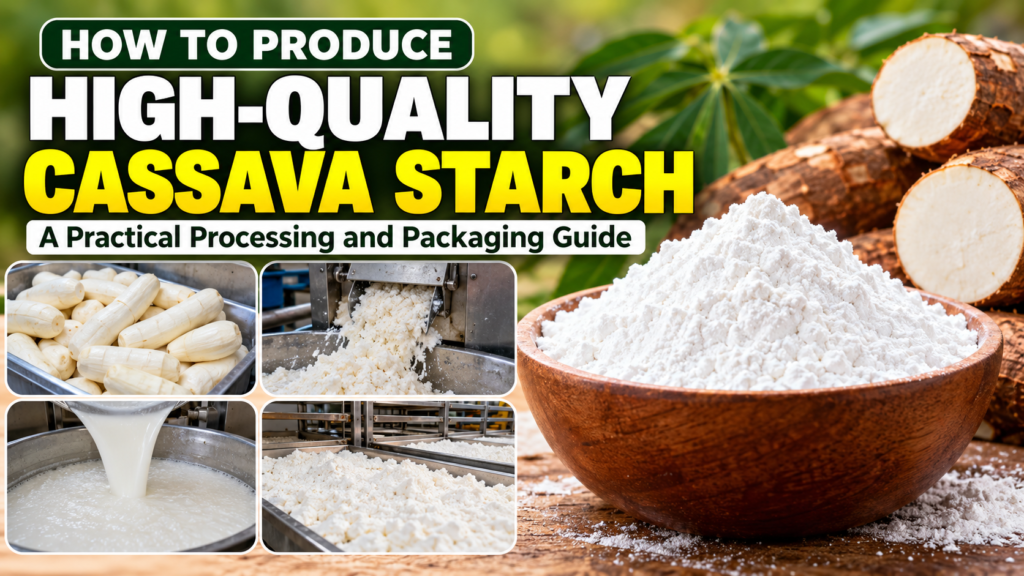
Cassava starch is a fine, white carbohydrate powder extracted from fresh cassava roots. It is widely used in food processing, baking, confectionery, sauces, snacks, pharmaceuticals and many industrial applications. Producing high-quality cassava starch requires careful raw-material selection, hygienic processing, efficient starch extraction, proper drying, milling and moisture-resistant packaging.
The quality of the finished starch depends greatly on how quickly fresh cassava roots are processed after harvesting and how well contamination is controlled throughout production. Poor handling can lead to discoloration, unpleasant odour, microbial growth and reduced starch quality.
This guide explains the practical steps for producing clean, smooth and commercially acceptable cassava starch suitable for household and small-scale commercial processing.
1. Selecting Fresh Cassava Roots
Begin with mature, healthy cassava roots that are firm and free from rot, mould, severe bruising or insect damage. Freshly harvested roots are preferred because cassava deteriorates rapidly after harvesting.
Process the roots as soon as possible to reduce discoloration and deterioration. Good-quality raw cassava helps produce starch with better colour, purity, texture and overall performance.
2. Peeling and Washing the Cassava
Remove the brown outer skin and the inner peel carefully. Wash the peeled cassava thoroughly with clean potable water to remove soil, sand and other contaminants.
Use clean equipment and hygienic handling throughout this stage because dirt introduced during washing can reduce the quality and appearance of the final starch.
3. Grating or Rasping the Cassava
Grate or rasp the washed cassava roots into a fine wet pulp using suitable food-processing equipment. Fine grating helps rupture the cassava cells and release the starch granules.
The grated pulp should be processed immediately rather than being left for long periods. Delays can encourage fermentation, discoloration and undesirable odours.
4. Extracting the Starch
Transfer the grated cassava pulp into a clean mixing container and add sufficient clean potable water. Mix thoroughly to release the starch from the cassava fibres.
Filter the slurry through a clean fine mesh, muslin cloth or suitable food-grade screen. Press or squeeze the pulp properly so that as much starch-rich liquid as possible passes through while the fibrous material is retained.
For better recovery, the remaining fibre may be washed again with a small quantity of clean water and filtered a second time.
5. Sedimentation and Separation
Collect the filtered starch liquid in a clean food-grade container and allow it to stand undisturbed. The starch granules will gradually settle at the bottom while lighter impurities remain suspended in the water.
After sufficient settling, carefully pour off the upper water without disturbing the starch sediment. Add clean water, stir the starch sediment and allow it to settle again.
Repeat the washing and settling process until the starch appears clean and white and the decanted water is relatively clear.
6. Dewatering the Wet Starch
After the final sedimentation, remove as much surface water as possible. Transfer the wet starch cake into a clean cloth, filter bag or suitable dewatering system.
Press gently but firmly to remove excess moisture. The starch should become firm and crumbly rather than watery before drying.
Good dewatering reduces drying time, improves efficiency and helps reduce the risk of microbial growth during processing.
7. Drying the Cassava Starch
Break the wet starch cake into small pieces and spread it in a thin, even layer on clean food-grade drying trays.
Dry using a controlled mechanical dryer, cabinet dryer, solar dryer or another hygienic drying system. Avoid direct contact with soil, dust, insects and other contaminants.
Dry until the starch is sufficiently low in moisture for safe storage and milling. Proper drying helps prevent mould growth, caking, unpleasant odour and deterioration during storage.
8. Milling the Dried Starch
Once the cassava starch is completely dry, break up any hardened pieces and mill them into a fine, smooth powder.
Use a clean, dry grinder or milling machine suitable for food processing. Avoid excessive heat during milling because unnecessary heat can affect product quality and encourage moisture condensation after packaging.
The objective is to obtain a uniform, free-flowing starch with a smooth texture.
9. Sieving and Grading
Pass the milled starch through a fine food-grade sieve to remove lumps, fibres and other unwanted particles.
A finer sieve produces a smoother and more uniform product, which is especially important when the starch is intended for baking, confectionery, sauces or other food applications.
Any oversized particles can be remilled and sieved again to improve product recovery.
10. Packaging the Cassava Starch
Package the finished starch immediately after cooling and sieving.
Use clean, food-grade, moisture-resistant packaging materials such as laminated pouches or properly sealed polyethylene bags. The packaging should protect the starch from moisture, insects, dust, odours and contamination.
Each package should clearly show important information such as the product name, net weight, production date, expiry or best-before date, batch number, storage instructions and manufacturer details.
11. Storage and Quality Control
Store packaged cassava starch in a cool, dry and well-ventilated area away from direct sunlight, water and strong-smelling materials.
For consistent commercial quality, regularly check the product for:
- clean white or cream appearance
- fine and uniform texture
- absence of unusual odour
- absence of insects or foreign matter
- low moisture and good flowability
- properly sealed packaging
Good sanitation, moisture control and proper storage are essential for maintaining product quality throughout its shelf life.
Conclusion
Producing high-quality cassava starch requires more than simply extracting starch from cassava roots. Good results depend on fresh raw materials, hygienic processing, effective washing and sedimentation, proper dewatering, controlled drying, fine milling and moisture-resistant packaging.
By controlling each stage carefully, processors can produce clean, smooth and commercially acceptable cassava starch suitable for household, food-processing and industrial applications.
You may also read our guide on how to produce high-quality cassava flour for more practical cassava-processing information.