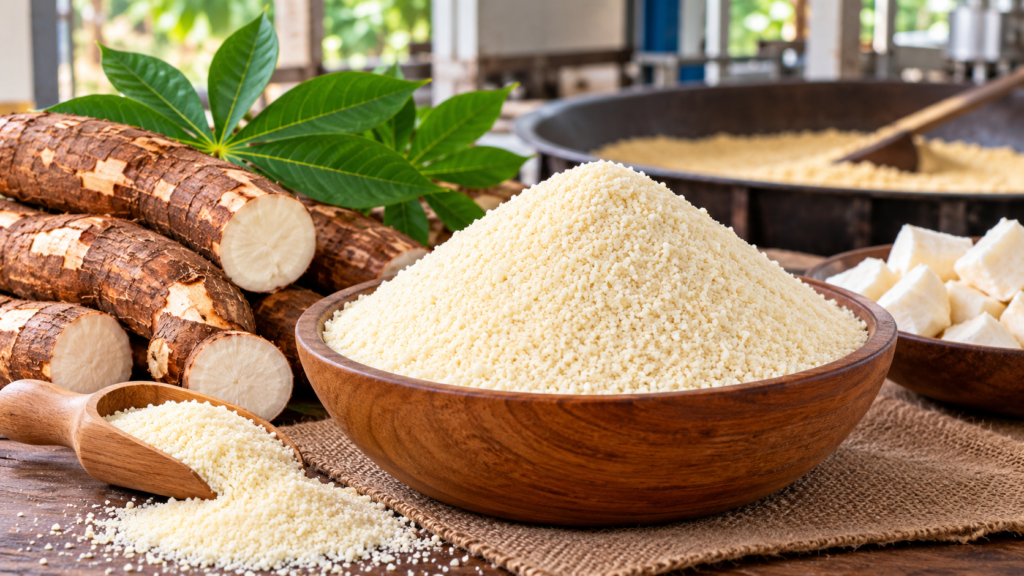
Garri is one of the most widely consumed cassava products in West Africa. Producing high-quality garri requires careful selection of fresh cassava roots, hygienic peeling and washing, proper grating, fermentation, dewatering, sieving, roasting and packaging. Each stage affects the colour, taste, texture, safety and shelf stability of the finished product. This guide explains the practical steps for producing clean, crisp and good-quality garri suitable for household consumption and commercial production.
1. Selecting Fresh Cassava Roots
Good garri begins with good cassava roots. Use fresh, mature cassava roots that are firm and free from rot, mould, severe bruising or insect damage. Process the roots as soon as possible after harvesting because prolonged storage can lead to deterioration, discolouration and poor flavour. Selecting clean and healthy roots helps improve the colour, taste, yield and overall quality of the finished garri.
2. Peeling and Washing the Cassava Roots
Peel the cassava roots carefully to remove the outer brown skin and the inner pinkish layer. Wash the peeled roots thoroughly with clean potable water to remove soil, sand and other contaminants. Proper washing is important because dirt left on the roots can affect the colour, taste and cleanliness of the finished garri. Use clean equipment and maintain good hygiene throughout this stage.
3. Grating the Cassava Roots
After washing, grate the cassava roots into a smooth mash using clean food-processing equipment. Grating breaks down the root structure and prepares the cassava for fermentation and dewatering. The grated mash should be collected in clean food-grade bags or containers and protected from dirt, insects and other sources of contamination. Good hygiene at this stage is important for producing safe, clean and good-quality garri.
4. Fermentation and Dewatering
Transfer the grated cassava mash into clean, strong food-grade bags and allow it to ferment while excess liquid drains away. Fermentation helps develop the characteristic garri flavour and reduces undesirable compounds naturally present in cassava. After fermentation, press the bags properly to remove as much water as possible. The mash should be firm and crumbly rather than wet before it moves to the next stage.
5. Sieving and Granulation
After dewatering, break the fermented cassava cake into smaller pieces and sieve it to obtain uniform granules. Sieving removes lumps and helps create an even particle size, which supports more consistent roasting. The granules should be loose, clean and free from foreign materials before they are transferred to the roasting stage.
6. Roasting the Garri
Roast the sieved cassava granules in a clean garri roasting pan or suitable mechanical roaster while stirring continuously. Proper roasting helps remove excess moisture, develops the characteristic texture and flavour, and reduces the risk of spoilage. The garri should become dry, crisp and evenly roasted without burning. Maintain consistent heat and avoid overcrowding the roasting surface so the product cooks uniformly.
7. Cooling, Sieving and Packaging
After roasting, spread the garri on a clean surface or food-grade tray and allow it to cool completely before packaging. If necessary, sieve the cooled garri again to achieve a more uniform particle size and remove oversized lumps. Pack the finished garri in clean, dry, food-grade moisture-resistant bags or containers and seal properly. Store it in a cool, dry place away from direct sunlight, moisture, pests and strong odours.
8. Quality Control and Food Safety
Maintain good hygiene throughout the entire production process. Use clean potable water, food-grade equipment and sanitary handling practices at every stage. Check the finished garri for colour, aroma, crispness, particle size and signs of moisture, mould or contamination before packaging. For commercial production, follow applicable food-safety requirements, keep proper production records and carry out appropriate laboratory testing where required.
Conclusion
Producing high-quality garri depends on careful cassava selection, hygienic processing, proper fermentation, effective dewatering, consistent roasting and good packaging. When each stage is well controlled, the result is clean, crisp and stable garri with good flavour and storage quality. Consistency, hygiene and moisture control are essential for producing a reliable product for both household and commercial use.
Learn more about FoodProdex and our work in food processing, product development and quality improvement.